The Right Fire Extinguisher for the Right Fire
If you ever need to use a fire extinguisher, knowing which one to pick is important.
Different types of extinguisher are designed for different types of fire. Using the wrong one can make a situation worse, which is why it is worth knowing what the colour coding means before you need it.
And remember: if in doubt – get out.
Fire extinguishers are intended to tackle a fire in its early stages, not a fire that is spreading or filling a room with smoke.
Fire extinguisher colour codes
Modern fire extinguishers normally have a red body, with a coloured band or area identifying the type of extinguishing agent inside.
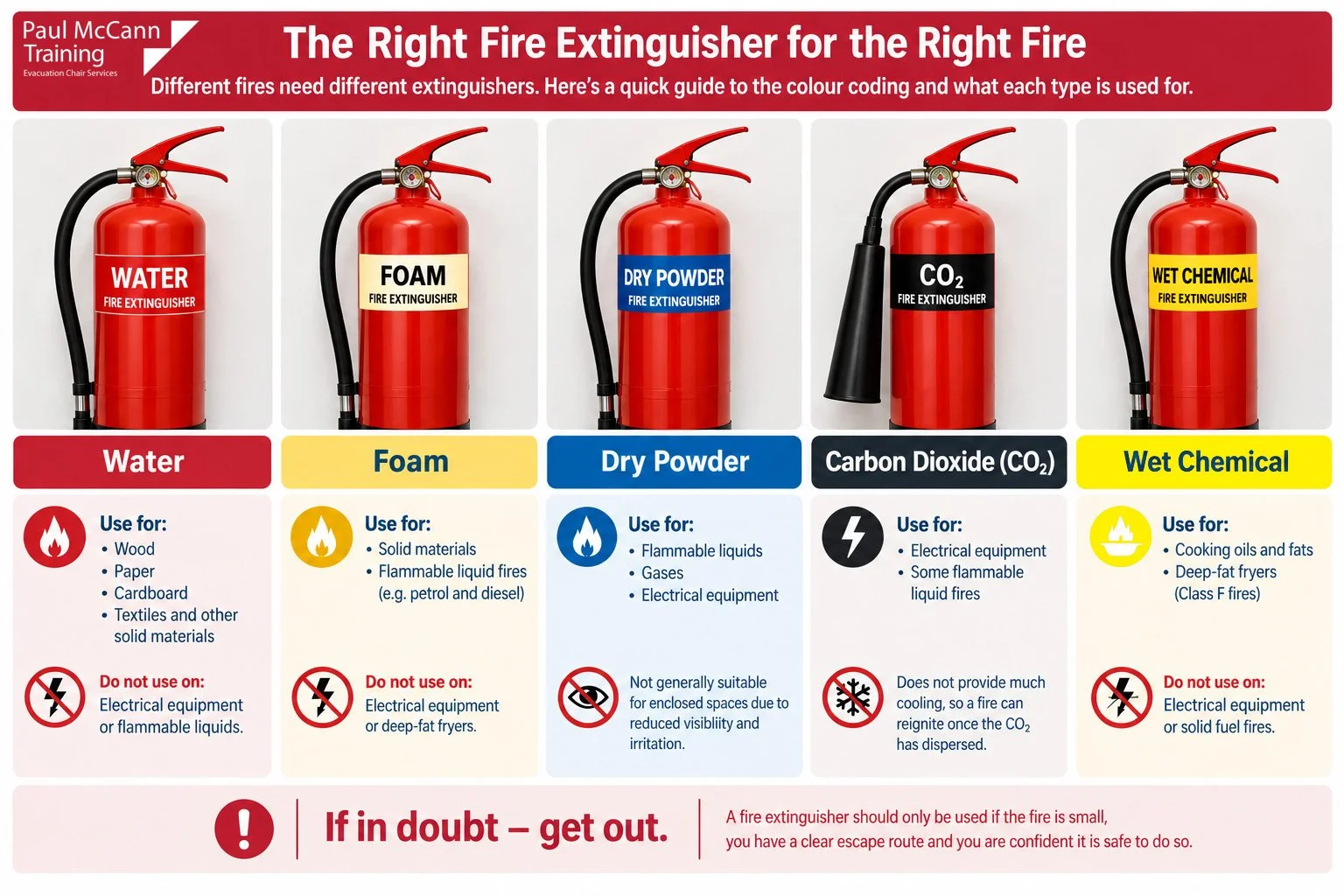
Fire extinguisher colour codes - click to download
Red – Water
Best for: wood, paper, cardboard, textiles and other solid materials.
Water works by cooling the burning material and is commonly found in offices, shops and other commercial premises.
Do not use water on: electrical equipment or flammable liquid fires.
Pale cream – Foam
Best for: solid materials and many flammable liquid fires, such as petrol and diesel.
Foam works by cooling the fire and forming a layer over the burning liquid.
Do not use foam on: electrical equipment or deep-fat fryers.
Blue – Dry Powder
Best for: a wide range of fires, including flammable liquids, gases and electrical equipment.
Powder extinguishers are versatile, but there is an important drawback: the powder can reduce visibility, make breathing difficult and can cause considerable contamination. They are therefore not generally suitable for enclosed spaces.
Black – Carbon Dioxide (CO₂)
Best for: electrical equipment and some flammable liquid fires.
CO₂ is particularly useful around electrical equipment because it does not leave a powder or foam residue.
However, it provides little cooling, so a fire can potentially reignite once the CO₂ has dispersed.
Canary yellow – Wet Chemical
Best for: cooking oils and fats, particularly deep-fat fryers.
Wet chemical extinguishers are specifically designed for Class F fires found in commercial kitchens.
They cool burning oil and help prevent reignition.
Why choosing the right extinguisher matters
It can be tempting to think that any extinguisher is better than none. But different extinguishing agents work in different ways.
For example, using water on a live electrical fire can create an additional hazard, while using an unsuitable extinguisher on burning cooking oil can cause the fire to spread.
The extinguisher should therefore be appropriate for the risks identified in your fire risk assessment.
What if you're not sure?
Don't take unnecessary risks.
A fire extinguisher should only be used if the fire is small, you have a clear escape route and you have been trained or are confident that it is safe to do so.
If the fire is spreading, there is a lot of smoke, your escape route could be blocked, or you are simply unsure what to do:
Raise the alarm. Get out. Call 999.
Your safety – and the safety of everyone else in the building – comes first.
Are your extinguishers right for your premises?
Having the right extinguisher is only part of good fire safety. Extinguishers also need to be correctly positioned, clearly identified and properly maintained.
If you're unsure whether your business has the right types of fire extinguisher, or whether they are in good working order, I can help.
I provide professional fire extinguisher servicing and fire marshal training for businesses and organisations across the West Midlands and surrounding areas.